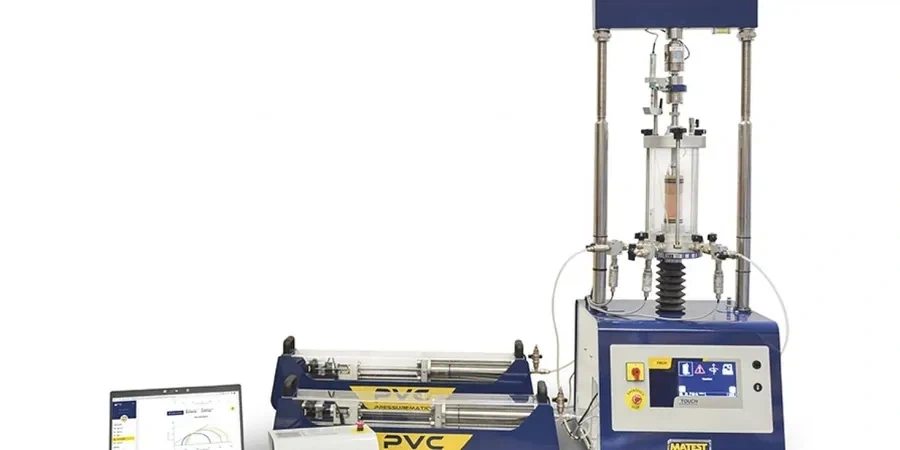
Across Winston-Salem, the Piedmont Triad’s residual soils don’t always behave the way textbook geology predicts. You’ll find saprolitic silts and micaceous sands derived from weathered schist and gneiss, which means the friction angle can shift dramatically depending on saturation and confining pressure. That’s exactly why a standard pocket penetrometer or even a basic unconfined compression test often falls short. We run triaxial tests because foundation engineers in Forsyth County need reliable drained and undrained shear strength numbers, not just generic presumptive values. Before finalizing a deep footing design near Salem Creek or evaluating a slope in the Ardmore neighborhood, pairing this data with a site-specific SPT drilling program helps us correlate lab behavior with actual in-situ density. When the geotechnical report lands on your desk, the effective stress parameters come from consolidated-undrained or consolidated-drained triaxial stages, not a lookup table. And for road embankments where compaction control is critical, we also tie the results back to Proctor test maximum dry density benchmarks so the placement specification matches the soil’s real strength envelope.
A triaxial test in Piedmont residual soil gives you the effective friction angle and cohesion intercept — the two numbers that control your entire foundation economy.
Scope of work
Area-specific notes
The saprolite mantle across Winston-Salem can be 30 to 80 feet thick, and its silt-dominated matrix retains a relic rock structure that collapses under shear if the confining stress is underestimated. When triaxial testing is skipped, the design often assumes a cohesion of zero and a conservative friction angle, which sounds safe — but it can actually backfire by overpredicting settlement and forcing unnecessary deep foundations. More dangerous is the opposite error: assuming a cohesion intercept from a quick undrained test that disappears once the soil drains and the pore pressure dissipates. In the Triad’s hot, humid summers, a cut slope that stood through a dry autumn can start creeping in July after a week of thunderstorms. Our consolidated-drained triaxial runs explicitly measure the drained friction angle, giving you a number that holds up under long-term groundwater conditions. For projects near Hanes Park or other developed corridors, we also recommend looking at the liquefaction potential of deeper granular layers if the water table is within 20 feet of the proposed footing elevation.
Standards used
ASTM D2850-23: Standard Test Method for Unconsolidated-Undrained Triaxial Compression Test on Cohesive Soils, ASTM D4767-20: Standard Test Method for Consolidated Undrained Triaxial Compression Test for Cohesive Soils, ASTM D7181-20: Method for Consolidated Drained Triaxial Compression Test for Soils, AASHTO T-297: Standard Method of Test for Consolidated-Undrained Triaxial Compression Test on Cohesive Soils, IBC 2024 Chapter 18: Soils and Foundations — referencing triaxial shear strength parameters
Linked services
Consolidated-Undrained (CU) with Pore Pressure Measurement
The most requested configuration for foundation design in Piedmont clays and silts. Specimens are saturated, consolidated to in-situ stress, then sheared at a slow rate while we record excess pore pressure. You get both total and effective stress envelopes, plus a stress path plot that tells you whether the soil is contractive or dilative at working loads.
Consolidated-Drained (CD) for Granular and Residual Soils
Ideal for Winston-Salem’s micaceous sands and saprolitic silts where long-term drained behavior governs. We run three specimens at different confining pressures and shear slowly enough to let pore pressure dissipate. The result is a clean drained friction angle you can plug directly into bearing capacity or slope stability calculations without guessing about consolidation time.
Typical parameters
Common questions
How much does a triaxial test program cost in Winston-Salem?
A standard three-specimen triaxial set (UU, CU, or CD) typically runs between US$2,160 and US$2,790, depending on specimen preparation complexity and whether back-pressure saturation is required. We deliver a firm quote after reviewing your boring logs and sampling plan.
What type of soil sample do you need for a triaxial test?
We need undisturbed samples — either thin-walled Shelby tubes (ASTM D1587) for cohesive soils or carefully trimmed block samples. Disturbed bag samples won't work because the in-situ density and structure are critical. Our team in Winston-Salem can coordinate directly with your drilling crew to ensure proper sealing, transport, and chain-of-custody documentation.
How long does it take to get triaxial test results?
A standard three-specimen CU or CD triaxial program takes about 7 to 10 business days from sample receipt, including consolidation and shear stages. UU tests are faster — usually 4 to 5 days. We can expedite for an additional fee if your contractor is waiting on foundation recommendations to mobilize.