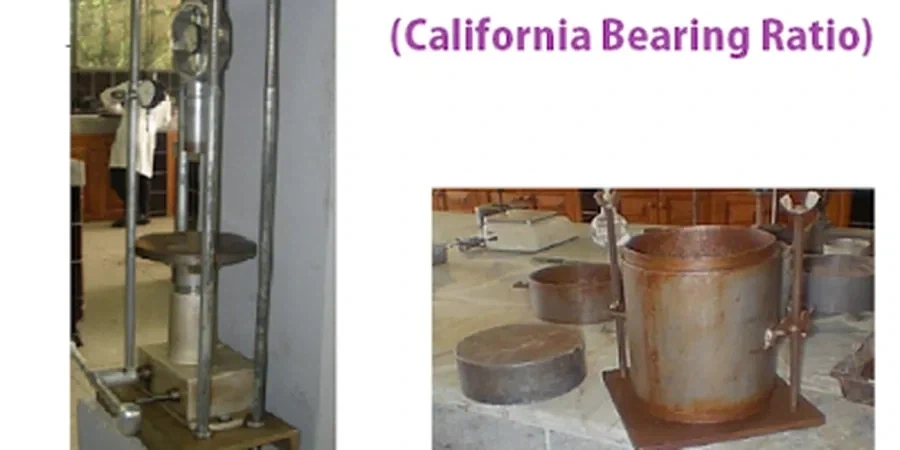
The steel loading piston presses into the compacted soil sample at 0.05 inches per minute while the proving ring captures every pound of resistance. That’s the core of a laboratory CBR test, and in Winston-Salem it matters more than most engineers expect. The Piedmont Triad’s residual silts and micaceous sandy clays can lose over half their bearing capacity when saturated, so running an ASTM D1883 soaked CBR isn’t optional—it’s what keeps a pavement section from failing two years after the ribbon cutting. Our Winston-Salem lab runs these tests on samples remolded to target moisture and density from Proctor tests, giving the design team numbers they can take straight into the AASHTO 1993 pavement design equation without second-guessing the subgrade.
A soaked CBR value on Piedmont residual soil is worth ten unsoaked numbers. Design with the wet value and the pavement will sleep easy.
Scope of work
Area-specific notes
A warehouse expansion off Hanes Mill Road a few years back went to slab pour with subgrade CBR values that looked fine on the dry-season report. Nobody ran soaked tests. Eighteen months later the floor slabs had differential settlement exceeding an inch, racking systems were out of plumb, and the owner was looking at a six-figure remediation. The problem wasn’t the compaction—it was the moisture sensitivity of the micaceous silt that nobody measured. In Winston-Salem’s humid subtropical climate, where annual rainfall averages 44 inches and the water table rises seasonally in the Triassic basin formations, ignoring soaked CBR is gambling with someone else’s building. The test takes four days of soaking and about an hour of actual penetration measurement, and it costs a fraction of what that warehouse repair did.
Standards used
ASTM D1883-21 (Standard Test Method for California Bearing Ratio of Laboratory-Compacted Soils), ASTM D698-12 (Standard Proctor compaction reference), AASHTO T 193 (CBR of laboratory-compacted soils, DOT specification)
Linked services
Soaked and Unsoaked CBR Curves
Full penetration curves with corrected CBR values at 0.1-inch and 0.2-inch displacement, plus swell measurement during the 96-hour soak. We report stress-penetration data in both psi and kPa for DOT and private-sector submittals.
Pavement Design Support Packages
We prepare subgrade strength summaries that integrate CBR results with Atterberg limits and Proctor data, formatted for direct input into AASHTO flexible pavement design or NCDOT standard pavement sections.
Typical parameters
Common questions
How much does a laboratory CBR test cost in Winston-Salem?
A single-point soaked CBR test (one moisture-density condition) typically runs between US$120 and US$210, depending on whether you need one compaction effort or a three-point curve. A full three-point CBR curve with Proctor correlation will be at the upper end of that range. We quote firm prices upfront so there are no surprises.
Do I need soaked or unsoaked CBR for a Winston-Salem pavement design?
Almost always soaked. NCDOT and most municipal specifications in the Triad require the 96-hour soaked CBR per ASTM D1883 because the Piedmont residual soils lose significant strength when saturated. Unsoaked values are supplementary at best and should not be used as the design input for flexible or rigid pavements in Forsyth County.
How long does the CBR test take from sample drop-off to report?
The soaking period alone is four days. Add one day for compaction and setup, and another day for penetration testing and report writing. Typical turnaround is five to six working days. We can expedite when the site contractor is waiting on a pour schedule.
What surcharge weight do you use during soaking?
We match the surcharge to your pavement structural section. For a typical Winston-Salem arterial with 2 inches of asphalt over 8 inches of aggregate base, that’s roughly a 10-pound surcharge on the 6-inch mold. For heavy industrial pavements or airfield sections we increase it accordingly, and we document the surcharge mass in the report so the design engineer can verify the assumption.