Plenty of contractors around here open up a test pit and think they know the soil because it looks like red clay. But around Winston-Salem, that Triassic basin geology can throw in layers of silt and fine sand that completely change the drainage profile. We run into this all the time in our lab. A full grain size analysis with hydrometer doesn't just classify the soil. It tells you whether your footing drains or holds water, and whether your subgrade is going to pump fines during freeze-thaw. For deeper projects near the Yadkin River floodplain, we often pair this with in-situ permeability testing to confirm lab predictions with field behavior. And when you need a complete picture of the profile before designing the foundation, a CPT sounding gives continuous soil stratigraphy that makes the gradation data actionable.
A D10 value under 0.02 mm in a foundation soil means capillary rise can reach several feet. That changes your vapor barrier spec.
Scope of work
Area-specific notes
The most common mistake we see in Winston-Salem is a design team using a default 'silty sand' classification from a visual log and skipping the hydrometer. Then the excavation hits a fat clay lens that nobody knew was there, and the slope stability assumptions fall apart. A grain size curve that shows a gap-graded or bimodal distribution means the soil doesn't compact the way standard Proctor tables predict. That leads to settlement, pavement cracking on Hanes Mall Boulevard-type commercial pads, or worse, differential movement under slab-on-grade. Skipping the full wash-sieve procedure also misses the true fines content, which directly impacts the liquefaction assessment if you're in a seismic design category D or E. We've pulled samples in Winston-Salem where the visual estimate was 15% fines and the wash came back at 34%. That difference changes the seismic site class from C to D under ASCE 7.
Standards used
ASTM D6913-22 (sieve analysis for particles >75 μm), ASTM D7928-21 (hydrometer analysis for particles <75 μm), ASTM D2487-17 (Unified Soil Classification System, USCS), AASHTO T 88-22 (particle size analysis of soils), IBC 2021 / ASCE 7-22 Chapter 20 (site classification)
Linked services
Standard combined analysis (sieve + hydrometer)
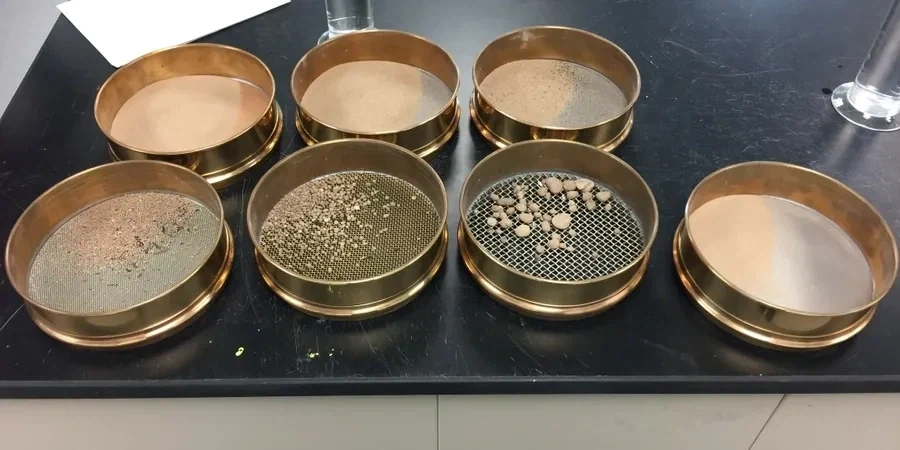
Full ASTM D6913/D7928 package. Covers 75 mm down to clay colloids. Includes D10, D30, D60, Cu, Cc, USCS classification, and a semi-log gradation plot ready for your report appendix.
Wash-sieve for fines content verification
Focused on the percent passing #200 sieve. Useful when the main question is drainage, frost susceptibility, or a quick check before a larger testing program.
Correlation with Atterberg limits
We recommend running Atterberg limits alongside any hydrometer test on Piedmont residual soils. The plasticity data plus the gradation curve give a complete USCS classification with group symbol (CL, CH, SC, SM, etc.).
Typical parameters
Common questions
How much soil do I need to send for a full grain size analysis?
For a combined sieve and hydrometer test, we need about 500 grams of material passing the #4 sieve. If the soil is mostly sand and gravel, send a 5-pound bag. Bag it in a sealed plastic bag so it doesn't lose moisture, and label it with the boring number and depth.
How long does the hydrometer part take?
The sedimentation readings run over a minimum of 24 hours. After that, we process the data, build the combined curve, and issue the report. Total turnaround from sample receipt is typically 2 to 3 business days. Rush service is available if you need it faster.
What does the grain size test cost in Winston-Salem?
A standard combined sieve and hydrometer analysis runs between US$110 and US$210, depending on whether you need the full hydrometer curve or just a wash-sieve for fines content. We'll give you a firm quote before starting any work.
Do you pick up samples from the job site?
We do sample pickup around Winston-Salem and Forsyth County for an additional fee. You can also drop samples at our lab. We'll coordinate timing so the samples don't sit in a truck bed drying out before they get to the oven.