The subsurface profile shifts dramatically when moving from the crystalline bedrock outcrops near Pilot Mountain State Park into the partially weathered saprolitic clays of the West End Historic District. In downtown Winston-Salem, the transition zone between the residual micaceous silts of the Sauratown Mountains antiform and the Triassic basin sediments creates a two-layer system that governs every deep excavation. A cut on Fourth Street encounters completely decomposed schist at 15 feet, while the same depth on Research Parkway hits stiff, structured clay with relict jointing. These variations demand a design approach rooted in ASTM D2487 classification and local piezometric data rather than generic earth pressure coefficients. The deep excavation design process begins with site-specific characterization of the partially saturated zone and the hydraulic conductivity contrast between the upper weathered mantle and the underlying competent rock.
Piedmont residual soils retain relict structure that controls the failure wedge geometry more than textbook friction angles suggest.
Scope of work
Area-specific notes
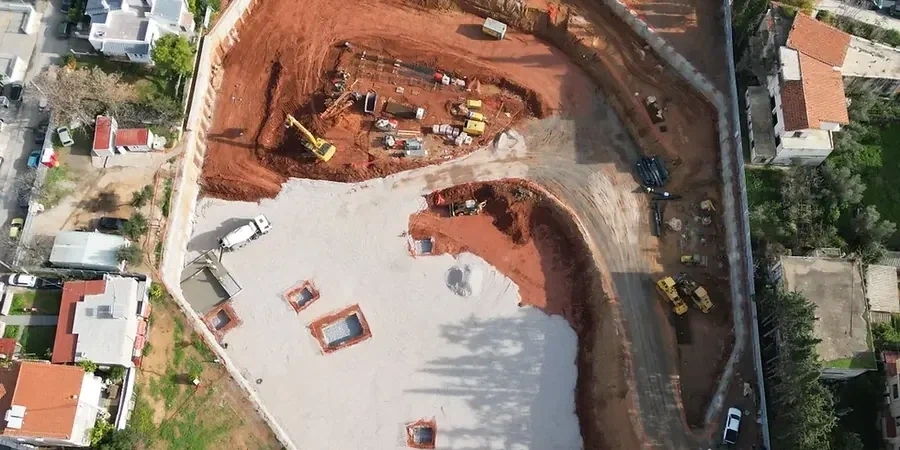
A Caterpillar 330 excavator working a bench cut near the RJ Reynolds warehouse district exposes the layered saprolite profile: stiff tan clay over soft white feldspar-rich silt over hard biotite gneiss. This vertical sequence, visible in every deep utility trench across Forsyth County, creates the classic condition for basal instability. The soft intermediate layer acts as a hydraulic barrier that traps perched water, reducing effective stress at the excavation base to near zero after extended pumping. The factor of safety against basal heave calculated using Terzaghi's bearing capacity method often drops below 1.2 unless the dewatering system penetrates through the confining layer. For excavations deeper than 30 feet in this geology, the monitoring program includes real-time inclinometer strings and automated total station prisms on adjacent historic masonry buildings along Trade Street. Pre-construction condition surveys and vibration monitoring are standard for structures within the zone of influence.
Standards used
ASCE 7-22 Chapter 20: Site Classification for Winston-Salem Piedmont Profiles, ASTM D2487-17: Classification of Residual Micaceous Soils, OSHA 29 CFR 1926 Subpart P: Excavation Protective Systems, IBC 2021 Section 3304: Earth Retaining Structures, FHWA GEC No. 4: Ground Anchors and Anchored Systems for Piedmont Saprolites
Linked services
Subsurface investigation for excavation support
Rotary wash borings with SPT sampling and pressuremeter testing in saprolite to define the engineering bedrock surface and lateral stress ratio.
Finite element modeling of staged excavation
Plaxis 2D and 3D models incorporating Hardening Soil with small-strain stiffness calibrated to local seismic CPTu data.
Temporary dewatering system design
Analysis of steady-state seepage using SEEP/W with anisotropic permeability tensors derived from packer tests in fractured gneiss.
Construction phase instrumentation and monitoring
Automated wireless inclinometer arrays and settlement points tied to city benchmark network with daily cloud reporting.
Typical parameters
Common questions
What is the typical cost range for geotechnical design of a deep excavation in Winston-Salem?
The geotechnical design scope for a supported excavation in the Winston-Salem area, including subsurface investigation, laboratory testing, and analysis of temporary support systems, generally ranges from US$1,920 to US$8,200 depending on excavation depth, proximity to adjacent structures, and the complexity of the groundwater control system. A simple utility trench design falls at the lower end, while a multi-level tied-back wall with instrumentation plans reaches the upper range.
How does the Piedmont saprolite affect earth pressure calculations?
The partially weathered saprolite common in Winston-Salem retains relict foliation and jointing from the parent rock, which creates anisotropic strength and permeability. Standard Rankine or Coulomb earth pressure theories often underestimate lateral loads because the apparent cohesion from matric suction can mask the true drained friction angle. We use local track record with suction-controlled triaxial testing and back-analysis of instrumented excavations to derive appropriate pressure diagrams for soldier pile and soil nail wall design.
What OSHA requirements apply to deep excavations in North Carolina?
All excavations deeper than 5 feet in Forsyth County must comply with OSHA 29 CFR 1926 Subpart P, which mandates protective systems designed by a registered professional engineer for excavations exceeding 20 feet. This includes site-specific analysis of soil classification per Appendix A, evaluation of surcharge loads from adjacent buildings on Fourth Street or Trade Street, and daily inspections by a competent person after rainfall events common during the Winston-Salem summer thunderstorm season.