The Piedmont residual soils of Winston-Salem present a specific challenge for excavation support. Saprolite derived from felsic gneiss and schist dominates the subsurface across Forsyth County. This material retains relict rock structure but behaves as a soil during loading. Anchor design here cannot rely on textbook rock mechanics. The partially weathered bands dictate bond zone capacity. A site on Burke Street will differ from one near Hanes Park. The geotechnical profile shifts within a few hundred feet. We specify active and passive anchors using data from test pits to identify the saprolite weathering grade, and combine this with SPT drilling to quantify N-values where the bond length will be placed.
Bond stress in Piedmont saprolite can drop by 40% across a single weathered joint—design must reflect this local variability.
Scope of work
We model multiple slip surfaces using Spencer's method integrated with anchor restraint. Each design includes a detailed submittal package: load-deformation curves, corrosion protection class, and proof testing procedures per ASTM A416. The bond zone is never assumed—it is field-verified with water pressure tests in the drilled hole before tendon placement.
Area-specific notes
The most common failure in local anchor design is treating Piedmont saprolite as uniform material. A contractor assumes 15 psi ultimate bond stress across the entire bond length. The upper 10 feet may deliver that value. The lower portion encounters a relict joint infilled with clay. Bond stress drops to 3 psi. The anchor creeps under proof load. The test fails. This scenario repeats because site investigation stops at SPT refusal without identifying the weathering profile. Another frequent error: placing the bond zone within the active wedge. The anchor contributes zero restraint. We always require a cross-section with the critical failure surface clearly drawn and the unbonded length dimensioned from that line. Corrosion protection is non-negotiable for permanent anchors in the acidic Piedmont groundwater.
Standards used
IBC 2021 Section 1810, ASCE 7-22 Chapter 2 Load Combinations, PTI DC35.1-14 Recommendations for Prestressed Rock and Soil Anchors, ASTM A416/A416M-18 Standard Specification for Low-Relaxation, Seven-Wire Steel Strand, AASHTO LRFD Bridge Design Specifications Section 11
Linked services
Temporary excavation tiebacks
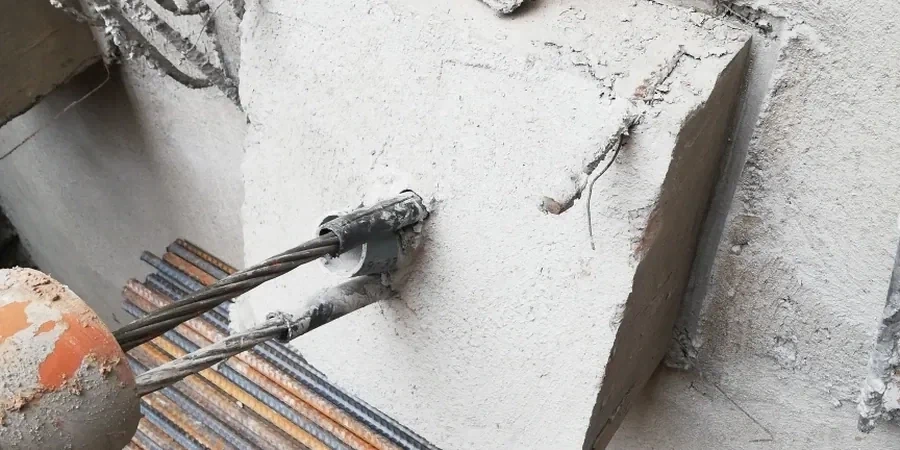
Active anchors for soldier pile and lagging walls. Designed for 12-24 month service life with basic corrosion protection. Proof tested to 133% of design load per project specifications.
Permanent retaining wall anchors
Double-corrosion-protected tendons for MSE walls and cast-in-place retaining structures. 75-year design life with encapsulated strand and factory-grouted sheathing.
Rock slope stabilization
Passive fully-grouted bars installed in weathered gneiss outcrops. No prestress applied. The bar mobilizes resistance as the slope deforms. Typical for cuts along US-421 and Silas Creek Parkway.
Typical parameters
Common questions
What determines active versus passive anchor selection?
Active anchors are prestressed and used where movement must be controlled—adjacent to existing buildings or utilities. Passive anchors are not tensioned; they mobilize resistance only when the soil mass deforms. In Winston-Salem, we specify active anchors for downtown excavations and passive anchors for rock slope stabilization where some displacement is acceptable.
How do you verify bond capacity in Piedmont saprolite?
We require water pressure testing (packer tests) in each anchor hole before tendon installation. The test identifies zones of high permeability associated with relict joints. If a joint is detected within the intended bond zone, we extend the hole deeper or shift the bond length. No bond stress value is assumed without field verification in this geology.
What does anchor design and testing cost in Winston-Salem?
Design fees plus proof testing typically range from US$910 to US$3,590 depending on the number of anchors, required corrosion protection class, and whether the project requires long-term monitoring. A single-family lot retaining wall with four passive anchors falls at the lower end. A commercial excavation with 40 active tiebacks and double corrosion protection falls at the upper end.
What load test is required after installation?
Every active anchor undergoes a proof test to 133% of the design load. We monitor creep movement over a 10-minute hold period. Creep must not exceed 0.04 inches between the 1-minute and 10-minute readings. For passive anchors, we perform a verification pull test on at least 5% of installed anchors to confirm bond stress assumptions.