Foundation systems form the literal base upon which every structure in Winston-Salem rests, from historic homes in Old Salem to modern commercial buildings downtown. This category encompasses the full spectrum of subsurface structural support: shallow footings, mat foundations, deep pile systems, and specialized solutions for problematic soils. In a city with Winston-Salem's geological diversity and development patterns, proper foundation engineering is not merely a construction requirement—it is a long-term investment in structural integrity and property value. The region's mix of residual soils, weathered rock, and varying water table conditions demands careful geotechnical evaluation before any foundation design begins.
Winston-Salem sits within the Piedmont physiographic province, characterized by deeply weathered metamorphic and igneous bedrock overlain by residual silty clays and sandy silts. The saprolite layer—weathered rock that retains the original texture but has lost significant strength—can extend tens of feet deep and poses unique challenges for foundation support. Expansive clay soils are present in many areas, particularly in the northern and eastern sections of Forsyth County, where moisture fluctuations can cause significant volume changes. Additionally, the presence of partially weathered rock zones and boulders within the saprolite complicates excavation and pile driving. Understanding these subsurface conditions through thorough geotechnical investigation is essential for selecting appropriate foundation types and avoiding costly failures.
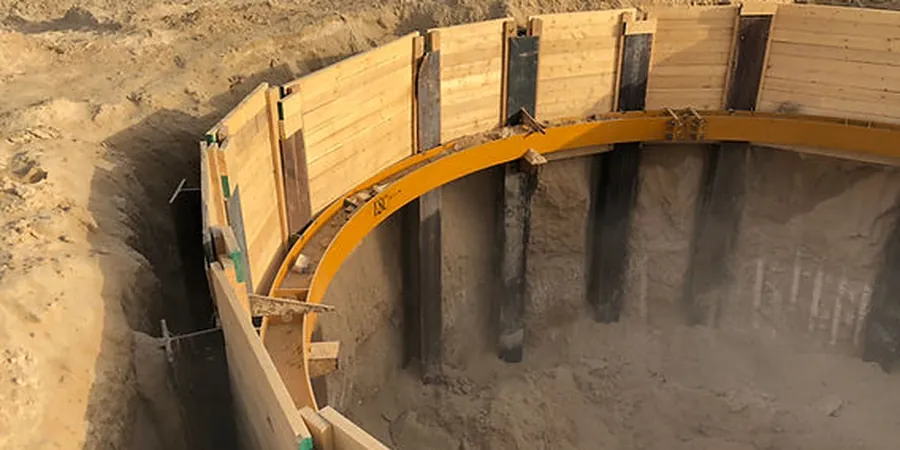
Foundation design in Winston-Salem must comply with the North Carolina State Building Code, which adopts the International Building Code (IBC) with state-specific amendments. Chapter 18 of the IBC governs soils and foundations, requiring geotechnical investigations for all structures except certain minor buildings. The code references ASCE 7 for load combinations and ACI 318 for concrete foundation elements. For deep foundations, IBC Section 1810 addresses driven piles, drilled shafts, and micropiles, with additional guidance from FHWA and AASHTO standards when applicable to transportation projects. Local jurisdictions, including the City of Winston-Salem and Forsyth County, may impose additional requirements for erosion control, steep slope development, and flood hazard zones. Engineers must also consider the North Carolina Residential Code for one- and two-family dwellings, which provides prescriptive foundation designs but allows engineered alternatives when soil conditions warrant.
Residential construction throughout Winston-Salem frequently relies on conventional spread footings and slab-on-grade systems, but problematic sites demand more sophisticated approaches. Commercial and institutional projects—such as the Wake Forest Innovation Quarter developments and medical facilities near Novant Health Forsyth Medical Center—often require deep foundations to reach competent bearing strata. Pile foundation design becomes critical when near-surface soils lack adequate bearing capacity or when settlement tolerances are tight. Industrial facilities, retaining walls, bridge abutments, and structures on steep slopes all present scenarios where specialized foundation engineering proves indispensable. Even renovation and addition projects in historic districts like West End can uncover foundation inadequacies that require underpinning or supplemental pile systems to meet current code requirements.
Available services
Common questions
What are the most common foundation problems in Winston-Salem's Piedmont soils?
The predominant issues stem from expansive clay soils that swell when wet and shrink during dry periods, causing differential movement and cracking. Deep saprolite layers present bearing capacity challenges, while the transition zones between weathered rock and competent bedrock complicate deep foundation design. Seasonal moisture variations and poor drainage exacerbate these conditions, particularly in older neighborhoods where foundation systems predate modern geotechnical standards.
When is a deep foundation system required instead of a shallow footing in this region?
Deep foundations become necessary when competent bearing strata lie too deep for economical shallow footings, typically beyond 10 to 15 feet depth. Indicators include weak or compressible near-surface soils, high groundwater tables, expansive clay layers thicker than 5 feet, or structural loads exceeding 2,000 pounds per square foot. Projects on steep slopes, in flood zones, or requiring uplift resistance also commonly trigger deep foundation requirements under IBC Chapter 18.
What geotechnical investigation is required before foundation design in Winston-Salem?
The North Carolina Building Code mandates a geotechnical investigation for all structures except certain minor buildings. This typically includes soil borings extending to a depth of at least 20 feet or to bedrock, standard penetration testing, laboratory classification and strength testing, and groundwater observation. The resulting report must deliver bearing capacities, settlement predictions, lateral earth pressures, and foundation recommendations specific to the site's subsurface conditions and proposed structure.
How do local building codes affect foundation design choices in Forsyth County?
Forsyth County and Winston-Salem adopt the North Carolina State Building Code, which follows IBC Chapter 18 with state amendments. These codes require foundations to be designed by licensed engineers when soil conditions fall outside prescriptive parameters. The code dictates minimum footing depths, allowable bearing pressures based on soil classification, and specific requirements for deep foundations including pile load testing. Local amendments may address frost depth considerations and hillside development restrictions.
Location and service area
We serve projects across Winston-Salem and surrounding areas.