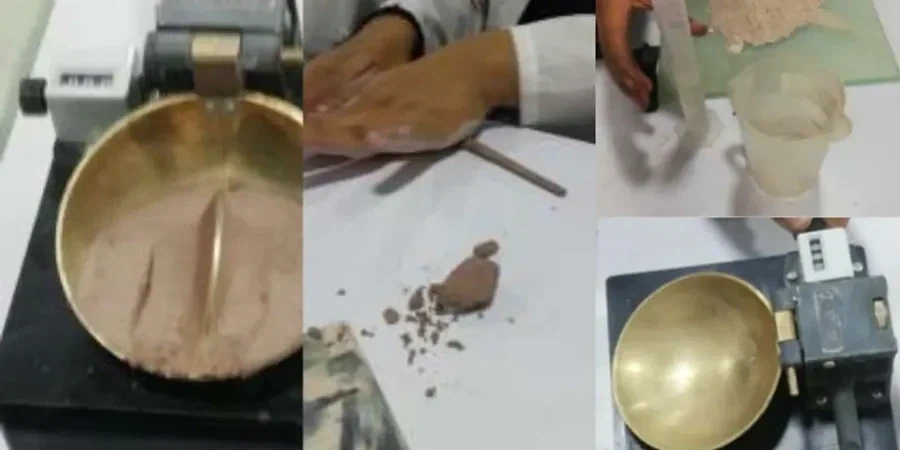
The brass cup of the Casagrande device drops at a steady two revolutions per second, striking the hard rubber base with a predictable thud that echoes through our mobile lab trailer just off Stratford Road. In Winston-Salem, where the saprolitic silts of the Piedmont province weathered directly from the underlying gneiss and schist, that rhythmic tapping determines the precise moisture content at which the soil transitions from plastic to liquid behavior — a parameter that dictates how much a foundation will heave when the red clay gets wet and shrink when it dries. Our technicians follow the procedure exactly as prescribed in ASTM D4318, rolling 3 mm threads of the minus No. 40 fraction until they crumble at the plastic limit, because even a half-percent deviation in water content can misclassify a soil that will later cause differential settlement in a slab-on-grade. We complement this work with a grain-size analysis when the fines content exceeds 50 percent, which is almost always the case in the Cecil series soils that dominate Forsyth County.
A plasticity index above 20 in the Triad's Piedmont silts almost always signals a shrink-swell potential that standard prescriptive footings cannot accommodate.
Scope of work
Area-specific notes
The most common mistake we see in Winston-Salem is a contractor who orders a standard Proctor and CBR for subgrade compaction but skips the Atterberg limits entirely, then wonders why the pavement heaves after an unusually wet winter. The Cecil and Appling soil series that blanket much of the county contain enough mica and kaolinite to look harmless in a hand auger sample, yet their plasticity index can spike dramatically in isolated lenses of weathered biotite schist. Without the liquid and plastic limit data, the geotechnical report will lack the necessary classification to trigger the IBC Section 1803.5.3 requirements for expansive soil mitigation, and the resulting foundation will lack the under-slab moisture barriers or deepened footings that local track record has proven necessary. We have also encountered situations where a laboratory report from outside the region classified a borderline ML-CL soil as non-expansive because the technician lacked familiarity with the Piedmont's saprolitic behavior, leading to designs that failed within three years of construction.
Watch how it works
Standards used
ASTM D4318-17e1: Standard Test Methods for Liquid Limit, Plastic Limit, and Plasticity Index of Soils, AASHTO T 89 / T 90: Determining the Liquid Limit / Plastic Limit of Soils, IBC 2021 Section 1803.5.3: Expansive soil investigation requirements, NCDOT Standard Specifications Section 101: Soil classification for earthwork
Linked services
Liquid and Plastic Limit Determination
Complete Atterberg limits testing on the minus No. 40 fraction in accordance with ASTM D4318, including multipoint liquid limit determination for precision classification.
Plasticity Index Correlation Studies
Relating measured PI values to empirical shrink-swell indices and undrained shear strength for use in local foundation design charts.
Activity and Mineralogical Screening
Calculating soil activity from PI and clay fraction, with qualitative assessment of dominant clay minerals based on the Holtz and Kovacs activity chart.
NCDOT Specification Compliance Testing
Atterberg limits testing formatted for North Carolina Department of Transportation subgrade acceptance, including chain-of-custody documentation.
Typical parameters
Common questions
What does the Atterberg limits test cost for a typical residential lot in Winston-Salem?
For a single-family home lot in Forsyth County, a complete Atterberg limits test including liquid limit, plastic limit, and plasticity index typically runs between US$60 and US$110 per sample when ordered as part of a broader geotechnical investigation. The exact cost depends on the number of samples required and whether the soil requires additional preparation, such as removal of mica-rich saprolite fragments that can bias the results.
How do Atterberg limits relate to expansive soil risk in the Piedmont Triad?
The plasticity index (PI) is the single most useful number for predicting shrink-swell behavior. In our Winston-Salem track record, soils with a PI below 12 rarely cause foundation problems, while those with a PI above 25 almost always require engineered mitigation such as deepened footings or moisture barriers. The relationship holds particularly well for the Piedmont's residual silts and clays because their activity values tend to cluster in a predictable range.
How many samples should be tested for a commercial building site in Winston-Salem?
We recommend testing every distinct stratum encountered in the borings, with a minimum of one Atterberg determination per 1.5 meters of depth in the active zone — roughly the upper 3 to 4 meters in this climate. For a typical commercial lot in the Hanes Mill Road corridor, that usually translates to 6 to 12 individual tests spread across the site to capture the lateral variability of the saprolitic profile.
Can you run Atterberg limits on soil samples that have already dried out?
Yes, and in many cases we prefer to test both air-dried and field-moist specimens from the same stratum. The Piedmont's residual soils often contain halloysite and other hydrated minerals that undergo irreversible changes upon first drying, so comparing the two results reveals whether the soil classification would shift from CL to ML simply due to construction exposure — a detail that matters enormously for compaction specifications and bearing capacity assumptions.