Ground improvement in Winston-Salem encompasses a suite of geotechnical techniques designed to enhance the engineering properties of soil and fill materials, enabling safe and economical construction. The city's variable subsurface conditions—ranging from residual soils derived from the weathering of the Piedmont bedrock to alluvial deposits along creek valleys—often present challenges such as loose sands, soft silts, and uncontrolled fill. Stone column design and vibrocompaction design represent two critical deep densification methods employed to mitigate these risks, increasing bearing capacity, reducing total and differential settlement, and providing liquefaction resistance where needed.
The local geology of Winston-Salem is dominated by the Piedmont physiographic province, characterized by saprolitic soils formed in place over felsic and mafic crystalline rocks. These residual soils can exhibit significant variability in density and stiffness over short distances. Additionally, urban expansion has led to the presence of anthropogenic fills—often undocumented and heterogeneous—that are unsuitable for supporting structural loads without treatment. In the broader Triassic basin sediments to the east and in localized floodplains, loose granular deposits may also be susceptible to vibration-induced settlement, making thorough geotechnical investigation essential before selecting an appropriate improvement strategy.
Design and execution of ground improvement in North Carolina must adhere to the standards set forth in the International Building Code (IBC) as adopted by the state, complemented by local Winston-Salem amendments. The geotechnical design typically follows guidelines published by the Federal Highway Administration (FHWA), such as the FHWA Ground Improvement Manual (FHWA-NHI-16-027), and relevant ASCE standards. For vibratory techniques, specifications like those from the Deep Foundations Institute (DFI) are commonly referenced. All improvement work requires special inspections and performance verification testing—such as cone penetration tests (CPT) or plate load tests—in accordance with IBC Chapter 17, ensuring the treated ground meets the project-specific acceptance criteria for settlement and capacity.
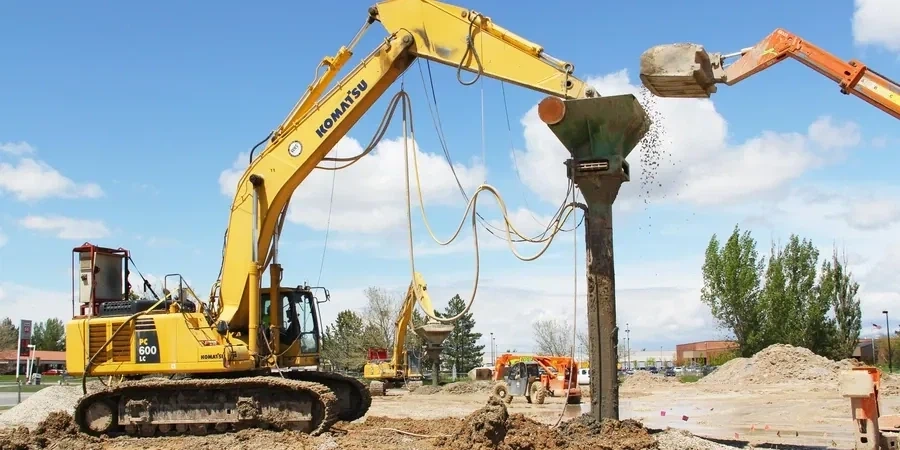
Projects across Winston-Salem that frequently necessitate ground improvement include commercial building developments on former agricultural or brownfield sites, warehouse and distribution centers requiring tight floor slab tolerances, and infrastructure such as bridge approaches and roadway embankments over soft alluvium. Vibrocompaction design is particularly effective for densifying clean, granular fills and natural sands, while stone column design provides a versatile solution for reinforcing cohesive soils and mixed fills through the installation of compacted gravel columns. The choice between these methods depends on the soil gradation, groundwater conditions, and the performance requirements of the superstructure.
Available services
Common questions
What are the primary benefits of ground improvement over traditional deep foundations in Winston-Salem?
Ground improvement methods like stone columns and vibrocompaction treat the soil mass in situ, often reducing or eliminating the need for deep piles. This can accelerate construction schedules, lower material costs, and decrease carbon footprint. In variable Piedmont residual soils and fills common to Winston-Salem, these techniques deliver uniform support for shallow foundations, effectively controlling settlement and improving bearing capacity across the entire site.
How do I determine which ground improvement method is suitable for my Winston-Salem site?
Method selection hinges on a thorough geotechnical investigation defining soil gradation, density, groundwater depth, and fines content. Clean granular soils respond well to vibrocompaction, which densifies through vibration. Cohesive or mixed soils typically require stone columns for reinforcement and drainage. A site-specific design evaluation, referencing local soil profiles and FHWA guidelines, is essential to match the technique to the subsurface conditions.
What testing is required to verify that ground improvement has met the design specifications?
Verification testing is mandated by the North Carolina building code and typically includes pre- and post-improvement cone penetration tests (CPT), standard penetration tests (SPT), or pressuremeter tests to quantify density and strength gains. For stone columns, modulus load tests or full-scale plate load tests are often performed. The specific frequency and location of tests are established in the project's quality assurance plan before work begins.
Are ground improvement techniques effective for mitigating earthquake-induced liquefaction in North Carolina?
While seismic hazard in Winston-Salem is moderate compared to the West Coast, liquefaction can occur in saturated, loose granular deposits. Both vibrocompaction and stone columns are proven liquefaction mitigation measures. Vibrocompaction densifies the soil matrix, while stone columns deliver drainage paths to dissipate excess pore water pressure. Design for this purpose follows FHWA and NCEER guidelines, adapted to the region's seismicity.
Location and service area
We serve projects across Winston-Salem and surrounding areas.