The geologic contrast between downtown Winston-Salem and the western suburbs near Hanes Mall is a factor many foundation designers overlook. The historic core sits on partially weathered saprolite over gneiss, while neighborhoods along Peters Creek are underlain by deep Quaternary alluvium with groundwater that rises seasonally to within 8 feet of grade. That difference alone determines whether a site falls into Seismic Site Class C or E under ASCE 7 Chapter 20, and it is exactly the kind of condition that triggers a mandatory liquefaction screening. We run these assessments using SPT blow counts correlated through the NCEER-1998 procedure with fines content from laboratory testing, because relying on CPT without understanding the weathered fabric of Triassic basin sediments here leads to false negatives. For deep profiles in the Hanes Mill Road corridor, we pair the analysis with in-situ permeability measurements to check drainage potential during shaking.
A factor of safety of 1.0 in liquefaction analysis means 2 to 4 inches of settlement in clean sands, enough to rupture utility connections and tilt lightly loaded footings.
Scope of work
Area-specific notes
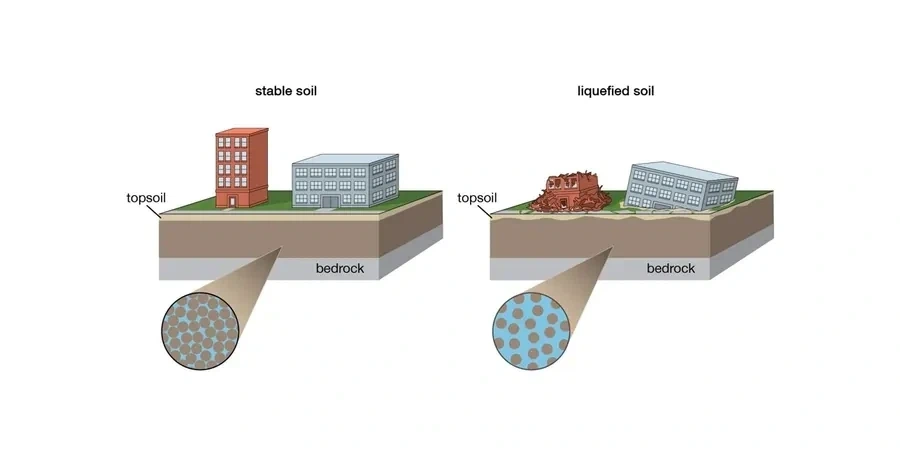
Winston-Salem sits at roughly 970 feet elevation on the Piedmont plateau, far enough from the Eastern Tennessee Seismic Zone that most contractors assume liquefaction is a West Coast problem. That assumption has caused foundation distress in at least three commercial projects I have reviewed in the last decade, all on saturated alluvial soils along the Yadkin River tributaries. The 5.1 magnitude Sparta earthquake in 2020, centered only 50 miles northwest, produced Modified Mercalli Intensity IV shaking in Forsyth County, enough to remind every geotechnical engineer in the Triad that moderate events can still generate excess pore pressure in loose, saturated silts. Soil liquefaction analysis quantifies that risk before the concrete pour, converting boring log data into a settlement forecast that the structural engineer uses to decide between deep foundations, Improvement, or accepting a calculated post-liquefaction displacement.
Standards used
ASCE 7-22 Chapter 21 (Site-Specific Ground Motion Procedures), NCEER 1998/2001 Workshop (Youd & Idriss simplified procedure), ASTM D1586-18 (Standard Penetration Test), ASTM D4318-17e1 (Atterberg Limits for fines characterization), IBC 2021 with North Carolina Building Code amendments
Linked services
SPT-Based Liquefaction Screening
NCEER simplified procedure with N1(60)cs correction. We apply the Seed-Idriss CSR calculation and deliver factor of safety profiles for every boring at 2.5-foot depth intervals.
Post-Liquefaction Settlement Analysis
Tokimatsu-Seed volumetric strain integration using corrected blow counts and CSR. Outputs include total settlement, differential settlement between columns, and angular distortion for foundation design.
Lateral Spreading Evaluation
Empirical displacement estimates using the Youd-Idriss approach for gently sloping ground near creeks and rivers. Critical for bridge abutments and buried pipelines.
Improvement Specification
When factor of safety falls below 1.1, we prepare performance-based specifications for vibrocompaction, stone columns, or jet grouting with post-treatment verification testing.
Typical parameters
Common questions
Is liquefaction analysis required by code for Winston-Salem projects?
Under ASCE 7-22 and the North Carolina-adopted IBC, liquefaction evaluation is mandatory for structures assigned to Seismic Design Category C through F when the site contains loose to medium-dense saturated sands within 50 feet of grade. Many sites along the Peters Creek and Muddy Creek floodplains meet this criterion.
How much does a liquefaction analysis cost for a typical commercial lot?
For a standard commercial building footprint in Winston-Salem requiring two to three SPT borings with laboratory fines content testing and a complete NCEER analysis, costs typically range from US$2,140 to US$4,650 depending on boring depth and whether groundwater monitoring wells are needed.
What soil types in Winston-Salem are most susceptible to liquefaction?
The Quaternary alluvium deposited by the Yadkin River tributary system, particularly loose silty sands with less than 35% fines content and standard penetration resistances below 15 blows per foot, are the primary liquefaction-prone units in Forsyth County. Residual soils derived from weathered gneiss are generally not susceptible.
What happens if the factor of safety against liquefaction is below 1.0?
A factor of safety below 1.0 indicates that excess pore pressure will reach effective overburden stress during the design earthquake. We then compute post-liquefaction settlement. If the predicted settlement exceeds the structural tolerance, we recommend either deep foundations bearing below the liquefiable layer or Improvement to increase the soil's cyclic resistance.