One of the most common missteps we see in Winston-Salem projects is assuming lab permeability values will hold up in the field. The Piedmont's residual silts and weathered mica schists don't behave the same way once you're dealing with natural fractures and relic joints. A lab remolding test simply cannot capture how water moves through a partially weathered rock mass. When a contractor skips the in-situ work and designs drainage or dewatering from a desk, the result is usually a wet excavation and an expensive delay. The test pits our team opens across Forsyth County consistently reveal saprolite zones where water flows along relict foliation planes, not through the matrix. That's where a proper Lefranc or Lugeon test becomes essential. We run these tests to ASTM D6391 standards, measuring hydraulic conductivity directly in the ground, at the depth that matters for your foundation or retaining structure. The numbers we get reflect the actual mass permeability, fissures and all.
Lab permeability on intact core often misses the fractures that control real water flow—that's why the Lugeon test matters in Piedmont bedrock.
Scope of work
Area-specific notes
Winston-Salem's growth from a Moravian settlement on Salem Creek to a modern manufacturing hub has left a layered geotechnical footprint. Downtown, you find old mill foundations and fill over natural alluvium. Out near Hanes Mall and the Stratford Road corridor, construction cuts into the saprolitic mantle derived from the Sauratown Mountains thrust sheet. This material can be stiff in the dry season but loses strength fast when water moves through it. For deep excavations or dam abutments, understanding how water travels through jointed bedrock is not optional. The Lugeon test tells us exactly that—packing off a section of borehole and measuring water take under pressure. It quantifies rock mass permeability in a way that lab tests on intact core cannot. In our track record, ignoring this step leads to overdesigned dewatering systems or, worse, slope instability during construction. We recently consulted on a retaining wall project near Peters Creek where the design changed completely once the in-situ permeability data came in. The original drainage plan was inadequate for the actual joint flow measured.
Watch how it works
Standards used
ASTM D6391-11, ASTM D4630-19, IBC 2021 Chapter 18, USACE EM 1110-2-1901
Linked services
Lefranc Variable & Constant Head Tests
For soils and weathered rock zones, we install a monitoring well or standpipe and measure infiltration rates under controlled hydraulic conditions. Data is analyzed using the Hvorslev or Bouwer-Rice methods to compute field-scale hydraulic conductivity.
Lugeon Packer Testing in Bedrock
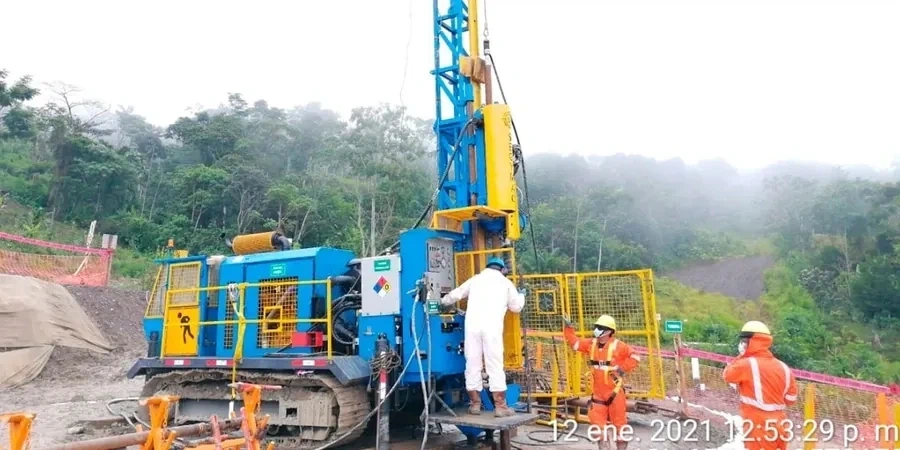
Using single or double packer assemblies, we isolate discrete intervals in NQ or HQ boreholes and apply stepped pressure stages. The resulting Lugeon values characterize fracture flow, joint connectivity, and rock mass permeability for dam, tunnel, and deep foundation projects.
Typical parameters
Common questions
When is a Lugeon test preferred over a Lefranc test in Winston-Salem?
A Lugeon test is the right choice when you're drilling into competent or fractured crystalline bedrock—common in the western parts of the city and along the Sauratown trend. The packer system isolates specific fracture zones, so you measure rock mass permeability rather than soil matrix flow. For residual soils and saprolite above the rock, the Lefranc method is more appropriate and cost-effective.
How long does a typical field permeability test program take?
A single Lefranc test interval usually takes two to four hours once the borehole is advanced, including setup, saturation, and steady-state measurement. A multi-stage Lugeon test in bedrock might run four to six hours per interval because of the stepped pressure cycles. A full program with several intervals often spans two to three field days, depending on access and drilling conditions.
What is the typical cost range for field permeability testing in this area?
For a standard field permeability testing program in the Winston-Salem area, budgets typically fall between US$710 and US$1,190, depending on the number of test intervals, access logistics, and whether Lefranc or Lugeon methods are required. We deliver a detailed proposal once we review the site geology and your project specifications.
Can you test permeability in existing monitoring wells?
Yes, we can perform falling-head or rising-head slug tests in existing wells that are properly constructed with a screened interval. The data interpretation follows the same Hvorslev or Bouwer-Rice methods as a purpose-drilled Lefranc test. Well condition and development history matter, so we always review the well log before quoting.
How do Piedmont residual soils affect permeability measurements?
The saprolite derived from mica schist and gneiss retains relict foliation planes that act as preferential flow paths. A Lefranc test captures this anisotropy because water moves into these natural fissures during the test. Lab tests on remolded samples destroy that fabric and nearly always underpredict the true field permeability by an order of magnitude or more.