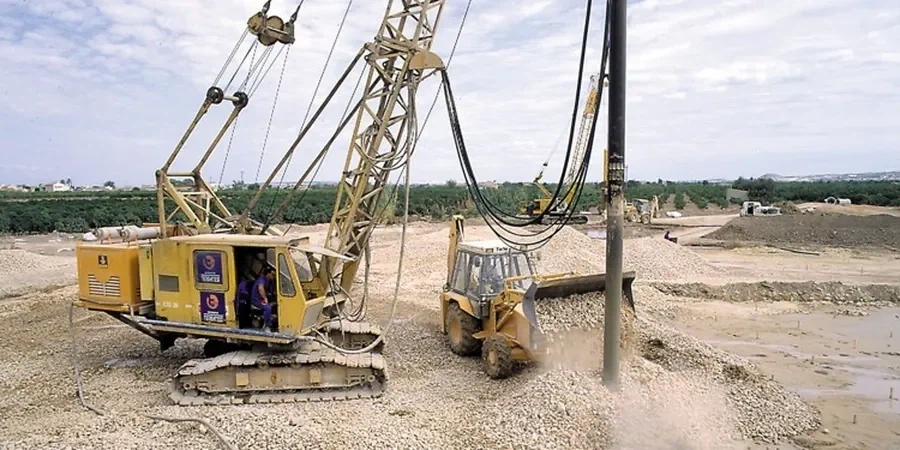
The vibrator probe hits the Piedmont saprolite and we watch the ammeter spike. That's the signal. In Winston-Salem, designing stone columns means reading the transition from residual soils to partially weathered rock—a contact that varies block by block across Forsyth County. We run the feed pipe down, gravel exits the ports, and the column builds from the bottom up. Each lift gets compacted in 12- to 18-inch increments. The backfill spec matters here: clean, angular crushed stone, typically 3/4 to 2 inches, meeting ASTM D448 gradation. Before any vibro-replacement design leaves our lab, we correlate the SPT N-values from the spt-drilling log with the target improvement ratio. The Triad's silty sands and micaceous clays don't respond like coastal plain soils. You need a design that accounts for the fines content and the natural moisture locked in the saprolite. That's what our stone column designs deliver: load transfer through a composite ground model, not a textbook assumption.
A stone column doesn't just densify—it drains. In Winston-Salem's silty residual soils, that drainage function cuts primary consolidation time by 80 percent or more.
Scope of work
Area-specific notes
Winston-Salem sits on the border between the humid subtropical Piedmont and the cooler foothills of the Blue Ridge. Summer thunderstorms dump two inches in an hour. Winter brings freeze-thaw cycles that heave shallow footings. These extremes punish soft ground. A warehouse slab on natural silty clay might settle 3 inches over five years. Add a poorly drained stormwater basin nearby and you get differential movement that cracks tilt-up panels. The biggest risk we see on local sites isn't bearing capacity failure—it's total and differential settlement under repeated wetting and drying. Stone column design addresses this by creating stiff, drained inclusions that shorten the drainage path and transfer load to a composite ground mass. We specify the area replacement ratio based on the post-treatment CPT tip resistance, often cross-checking with the cpt-test data from adjacent borings. Without this, the clay matrix consolidates slowly and the owner inherits a maintenance headache that no amount of slab jacking can fix permanently.
Standards used
ASTM D1586-18 Standard Test Method for Standard Penetration Test (SPT), ASTM D2487-17 Standard Practice for Classification of Soils for Engineering Purposes, IBC 2021 Chapter 18 Soils and Foundations, FHWA-NHI-16-027 Improvement Methods
Linked services
Geotechnical Investigation for Vibro-Replacement Design
We drill and sample the target stratum to 10 feet below the planned column tip. SPT N-values, moisture content, and Atterberg limits are determined for each lift. We classify the soil per ASTM D2487 and deliver the fines content and plasticity index needed to select the appropriate vibro-replacement method. The report includes a recommended area replacement ratio, column spacing grid, and estimated settlement under the design load.
Post-Installation Verification Testing
After the stone columns are installed, we confirm performance with CPT soundings between columns and plate load tests on the composite ground. The CPT data is compared to the pre-treatment baseline to verify the improvement ratio. We also run grain-size analyses on the delivered aggregate to confirm it meets the ASTM D448 gradation specified in the design.
Typical parameters
Common questions
How much does a stone column design package cost for a Winston-Salem commercial site?
For a typical commercial building pad in Forsyth County, the design package including subsurface exploration, laboratory testing, and the stone column specification ranges from US$1,550 to US$5,160. The final cost depends on the number of borings required, the depth of treatment, and the complexity of the loading conditions.
What soil conditions in Winston-Salem make stone columns a good choice?
Stone columns work well in the silty sands, soft clays, and mixed fill found across the Triad. They deliver densification and drainage in soils with fines content up to 15-20%. For thicker clay deposits with higher plasticity, we evaluate the undrained shear strength and may recommend a bottom-feed installation to maintain column integrity during construction.
How long does the design process take from investigation to stamped drawings?
A typical timeline is three to four weeks. Week one covers drilling and sampling. Week two is laboratory testing for gradation, moisture, and Atterberg limits. Week three involves the unit cell analysis and generation of the column layout and specification. Week four allows for review and coordination with the structural engineer on the load transfer platform interface.
Can stone columns be installed close to existing foundations in downtown Winston-Salem?
Yes, but with precautions. We specify vibration monitoring and a minimum setback distance based on the building condition and foundation type. For sensitive structures like unreinforced masonry buildings near Trade Street, we may recommend a pre-construction condition survey and real-time vibration thresholds not exceeding 0.5 in/sec peak particle velocity.
What's the difference between wet top-feed and dry bottom-feed stone columns?
The reference range for this service in Winston-Salem is US$1.550 - US$5.160. The final price depends on the project scope and volume.