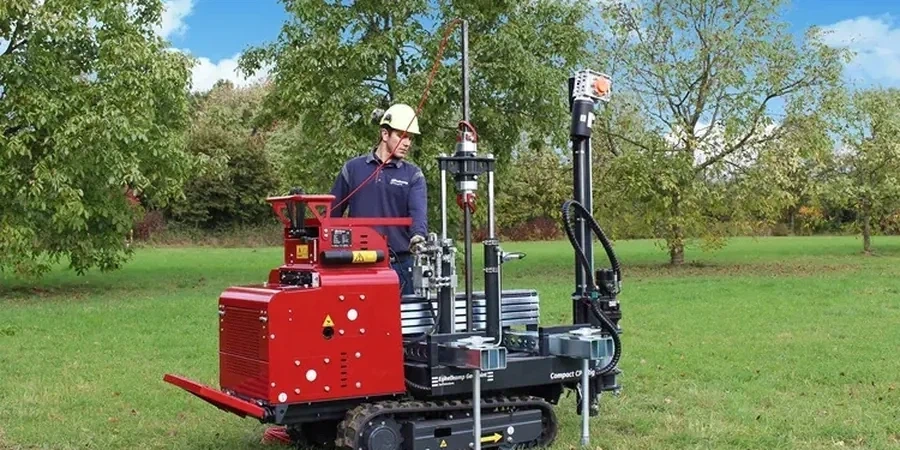
On a project off Reynolda Road last spring, we watched a contractor struggle with standard SPT refusal at 15 feet in what the county soil survey called Cecil sandy loam. That residual profile, weathered directly from the underlying mica schist, is exactly where CPT testing in Winston-Salem proves its value. The cone reads the transition from saprolite to partially weathered rock continuously, giving engineers a vertical signature that an SPT spoon simply cannot capture. In the Triad region, where Piedmont residuum can shift from stiff clay to highly fractured rock within a vertical foot, having uninterrupted tip resistance and sleeve friction data changes the foundation design conversation entirely. We run a 20-ton truck-mounted rig across Forsyth and surrounding counties, pairing the CPT profiling with seismic shear wave collection when IBC site class confirmation is required for commercial permits.
In Piedmont residual profiles, a continuous CPT trace often reveals a saprolite-to-rock transition that SPT blow counts completely miss.
Scope of work
Area-specific notes
We reviewed a site off Stratford Road where a developer planned a five-story mixed-use building on spread footings based solely on nearby boring logs. Our CPT soundings revealed a 6-foot-thick lens of soft, micaceous silt at 12 feet depth that the borings had completely missed between sample intervals. That layer, when analyzed with the normalized soil behavior type index from the cone data, showed undrained shear strength below 800 psf. The structural engineer shifted to an intermediate foundation system with Improvement. In Winston-Salem, ignoring the continuous profile that CPT delivers can mean missing a compressible layer sitting directly beneath a footing influence zone. The cost of a supplemental cone program runs a fraction of what a post-construction settlement remediation costs in the Triad market.
Standards used
ASTM D5778-21 – Standard Test Method for Electronic Friction Cone and Piezocone Penetration Testing of Soils, IBC 2021 – Section 1803 Foundation and Soil Investigation, ASCE 7-22 – Chapter 20 Site Classification Procedure, FHWA-NHI-16-072 – Geotechnical Site Characterization (Cone Penetration)
Linked services
Commercial Foundation CPT
Piezocone soundings for office, medical, and mixed-use projects in Winston-Salem requiring IBC site class and bearing capacity parameters.
Residual Soil Profiling
High-resolution logging through Cecil and Pacolet series residuum to identify saprolite consistency, rock refusal depth, and compressible seams.
Pore Pressure Dissipation Testing
In-situ consolidation coefficient estimates for Piedmont silts and clays using u2 decay curves, critical for settlement analysis.
CPT-MASW Combined Site Class
Integrated cone and shear wave velocity profiling to establish Vs30 and IBC site class without mobilizing a separate seismic crew.
Typical parameters
Common questions
What does a CPT test in Winston-Salem typically cost?
For standard projects in the Winston-Salem area, cone penetration testing generally ranges from US$180 to US$260 per sounding hour, depending on depth, access conditions, and whether pore pressure dissipation tests are included. A typical commercial site investigation with three to five soundings to 60 feet will be quoted as a lump sum after we review the parcel and the engineer’s scope.
How deep can the CPT rig push in Piedmont residual soils?
In the Cecil and Pacolet series residuum common across Forsyth County, our 20-ton rig typically reaches refusal between 40 and 80 feet, depending on the degree of weathering and the presence of quartz veins. When the cone encounters partially weathered schist with tip resistance exceeding 400 tsf, we stop and log the refusal depth. We have reached 100 feet in deeply weathered saprolite profiles south of the Salem Creek drainage.
Does CPT replace SPT borings for IBC site classification?
CPT provides continuous tip resistance and sleeve friction data that IBC 2021 recognizes for foundation design parameters, but the code still requires shear wave velocity or standard penetration resistance for site class determination. Our typical approach in Winston-Salem pairs the CPT sounding with a downhole seismic module to collect Vs data in the same push, satisfying the ASCE 7 site class requirements without a separate drilling crew.
How soon after testing do we receive the CPT data?
We deliver digital CPT logs in PDF and Excel formats within two business days of field completion. The logs include corrected cone resistance, friction ratio, pore pressure, and normalized soil behavior type classification. For projects on a fast-track schedule, we can deliver raw data charts the same day so the geotechnical engineer can begin preliminary foundation calculations immediately.