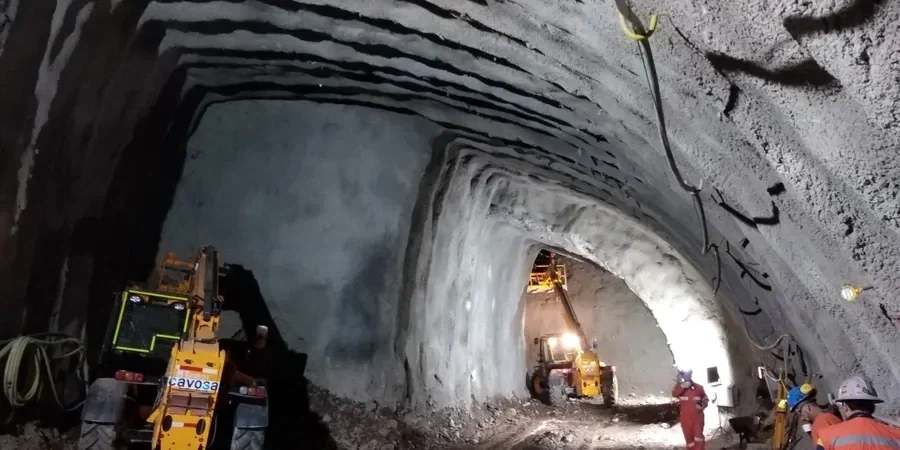
A utility tunnel alignment near Peters Creek Parkway encountered 22 feet of micaceous silt before hitting weathered schist. The contractor lost three days to face sloughing because the geotechnical baseline report missed the transitional saprolite zone. Winston-Salem sits on the edge of the Triassic basin, and the Piedmont residuum here does not behave like textbook clay. It has structure. It has relic foliation. It loses strength fast when disturbed. A standard subsurface program with split-spoon sampling is not enough. You need undisturbed Shelby tubes. You need pore pressure readings. You need lab strength at natural moisture content. The difference between a successful drive and a collapse in soft ground is knowing the soil’s sensitivity before the cutterhead touches it. Our team integrates CPT testing for continuous stratigraphy and triaxial testing for effective stress parameters on the same formation, giving the design engineer a complete mechanical profile of the ground.
Residual soil in the Piedmont has relic structure that confuses standard SPT-based design. You need lab strength at natural moisture content.
Scope of work
- Deformation modulus from triaxial unload-reload loops.
- Stand-up time estimated from plasticity index and face stability charts.
- Convergence-confinement curves built from lab and field data.
Area-specific notes
A truck-mounted drill rig with automatic SPT hammer positions over the borehole. Hollow-stem augers rotate into the silty residuum. At 8 feet, the crew hits groundwater perched on the weathered rock surface. The auger flights pull up soupy cuttings. The driller notes a 3-foot drop in water level after the sampler is driven. That perched water lens, common across Winston-Salem’s interfluve slopes, was not on any regional map. In a tunnel, that lens becomes a localized inflow, softening the face, triggering raveling. If the contractor does not expect it, the ground loss propagates upward and a sinkhole opens at the pavement. Our investigation protocol includes standpipe piezometers sealed at multiple depths to isolate these transient aquifers. We also measure Atterberg limits and shrinkage ratio on the saprolite to predict volume change during seasonal wet-dry cycles. Skipping the perched water survey in Piedmont residuum is the single most frequent cause of soft-ground tunnel instability we observe.
Watch how it works
Standards used
ASTM D1586-18: Standard Test Method for Standard Penetration Test (SPT) and Split-Barrel Sampling of Soils, ASTM D4767-11: Standard Test Method for Consolidated Undrained Triaxial Compression Test for Cohesive Soils, ASTM D2487-17: Standard Practice for Classification of Soils for Engineering Purposes (Unified Soil Classification System), ASTM D4318-17: Standard Test Methods for Liquid Limit, Plastic Limit, and Plasticity Index of Soils, FHWA-NHI-10-034: Technical Manual for Design and Construction of Road Tunnels – Civil Elements
Linked services
Subsurface Exploration for Tunnel Alignment
Rotary wash borings with SPT and Shelby tube sampling along the proposed alignment. Piezometer installation in perched water zones. Downhole shear wave velocity measurements for site class determination per ASCE 7.
Advanced Laboratory Testing on Residual Soils
CIUC and UU triaxial tests on undisturbed specimens. One-dimensional consolidation tests for settlement prediction. Atterberg limits, hydrometer analysis, and specific gravity for full soil classification.
Tunnel Face Stability and Settlement Analysis
Convergence-confinement modeling using lab-derived parameters. Empirical assessment of stand-up time based on soil sensitivity and groundwater conditions. Surface settlement trough prediction for urban infrastructure protection.
Typical parameters
Common questions
What soil conditions in Winston-Salem cause the most problems for soft-ground tunneling?
The micaceous silt saprolite derived from weathered schist and gneiss is the main challenge. It retains the parent rock’s foliation structure but has the consistency of stiff silt. When exposed at the tunnel face, it can slough within hours if the natural moisture content changes. Perched groundwater lenses above the weathered rock contact add to the instability, creating localized inflows that soften the face.
What is the typical cost range for a geotechnical investigation for a soft-ground tunnel project?
A complete investigation program — including borings, undisturbed sampling, piezometer installation, triaxial testing, and engineering analysis — generally ranges from US$3,880 to US$17,100 depending on the length of the alignment, the number of boreholes, and the laboratory testing scope required.
How do you determine stand-up time for a tunnel face in residual Piedmont soils?
We estimate stand-up time from the soil’s sensitivity, plasticity index, and in-situ moisture content. Undisturbed Shelby tube samples are tested in triaxial compression to measure undrained shear strength and stiffness degradation. These values feed into analytical charts that predict how long the face remains stable without support, which directly influences the choice between sequential excavation, forepoling, or full-face tunneling.