In Winston-Salem, the transition zone between the Piedmont residual soils and the Triassic basin sediments creates a profile where loose alluvial sands and uncontrolled fill appear at depths that complicate shallow foundation performance. Many sites near Peters Creek or the Yadkin River terraces show SPT N-values below eight in the upper twenty feet—conditions where conventional compaction grouting or surcharge alone cannot ensure the required bearing capacity. Our CPT testing provides continuous tip resistance and sleeve friction logs that feed directly into vibrocompaction design, and when we need to verify post-treatment improvement we frequently rely on grain size analysis to confirm that the gradation still favors effective densification under vibratory energy. A vibrocompaction program designed without understanding the local saprolite depth—which in Forsyth County can vary from ten to over sixty feet—risks both under-treatment and unnecessary cost overruns.
Achieving a post-treatment relative density above 70% in Triassic basin sands requires matching vibrator frequency to the soil's grain-size distribution, not just applying maximum energy.
Scope of work
Area-specific notes
Winston-Salem’s industrial expansion along the I-40 and US-52 corridors has repurposed land that was once low-lying farmland or reclaimed creek floodplain, where decades of undocumented fill placement created zones of loose, heterogeneous material with collapse potential under saturated loading. The 2020 earthquake near Sparta—a magnitude 5.1 event felt across the Piedmont—reminded engineers that North Carolina is not immune to intraplate seismicity, and the IBC now maps portions of Forsyth County within a site class transition that can amplify short-period ground motion. Omitting vibrocompaction design in these subsurface conditions exposes a project to differential settlement exceeding two inches across column grids, post-construction foundation distress, and, for essential facilities, a liquefaction-induced loss of bearing that standard SPT-based screening would flag as unacceptable. When a site investigation reveals a corrected SPT blow count below ten and a fines content under 15%, the risk of not densifying the deposit is simply not defensible under the standard of care expected in North Carolina geotechnical practice.
Standards used
ASTM D6066-21: Standard Practice for Determining the Normalized Penetration Resistance of Sands for Evaluation of Liquefaction Potential, IBC 2021 Chapter 18: Soils and Foundations, including Section 1805 on deep foundations and Improvement, ASCE/SEI 7-22: Minimum Design Loads and Associated Criteria for Buildings and Other Structures, Chapter 20 Site Classification, ASTM D1586-18: Standard Test Method for Standard Penetration Test (SPT) and Split-Barrel Sampling of Soils, ASTM D5778-20: Standard Test Method for Electronic Friction Cone and Piezocone Penetration Testing of Soils
Linked services
Vibrocompaction Trial Program and Production Design
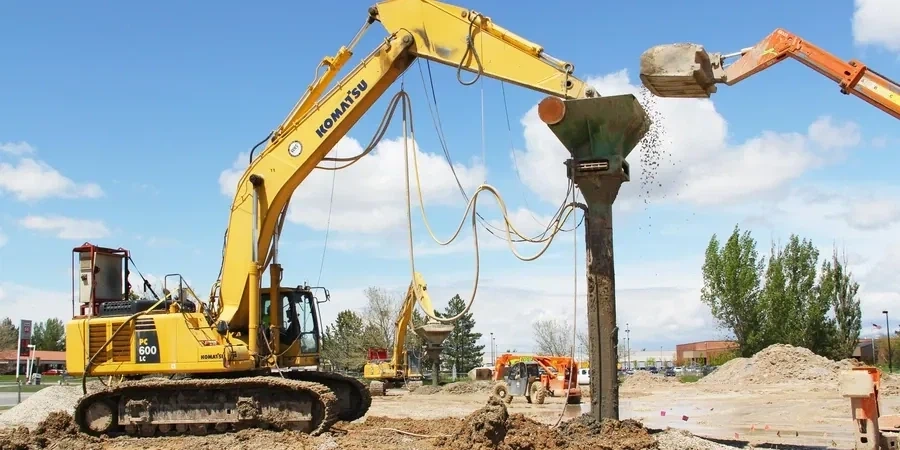
We establish probe type, grid geometry, lift thickness, and hold-time criteria through a pre-production trial section, monitoring amperage and settlement in real time to calibrate energy input against the target relative density. The production plan includes sequencing, water pressure management for the silty sands of the Pine Hall Formation, and contingency adjustments for zones where CPT tip resistance fails to reach the 120-tsf threshold after the first pass.
Post-Treatment Verification with SPT and CPT Correlation
Post-densification testing compares pre- and post-improvement SPT N-values and CPT tip resistance within the treatment footprint, generating improvement ratios and statistical coverage plots that demonstrate compliance with the specified minimum Dr. We cross-correlate results with gradation shifts observed in post-treatment samples, ensuring that the vibratory energy has not simply rearranged fines into lenses that could compromise long-term drainage.
Typical parameters
Common questions
What subsurface conditions in Winston-Salem make vibrocompaction the preferred Improvement method over stone columns or deep soil mixing?
Vibrocompaction works best in clean to slightly silty sands with fines content below 15 to 18 percent—conditions found in the alluvial terraces along the Yadkin River and in the Triassic basin sands of Forsyth County. When CPT logs show a soil behavior type index Ic below 2.05 and SPT N-values under 10, the vibratory probe can densify the deposit to a relative density above 70% without importing stone backfill, which keeps both cost and carbon footprint lower than stone columns for large-footprint warehouse or industrial pads. If the fines content exceeds 20%, we typically recommend switching to stone columns, because excess silt dampens the vibratory energy transfer and prevents effective densification.
How do you verify that the vibrocompaction treatment met the specified density target before foundation construction begins?
Verification relies on a combination of pre- and post-treatment In-Situ: SPT borings per ASTM D1586 advanced at the centroid and midpoint of the treatment grid, and CPT soundings per ASTM D5778 to capture continuous penetration resistance profiles. We compare the corrected N1,60 values and tip resistance qc before and after treatment, calculating the improvement ratio and plotting the post-treatment data against project-specific acceptance envelopes. Where the specification requires a minimum Dr of 70%, we correlate the field data using the Kulhawy and Mayne or Baldi relationships, and we also check that the inter-probe settlement during treatment stabilized to less than one inch per pass at the design energy level.
What is the typical cost range for vibrocompaction design and treatment in the Winston-Salem area?
For a mid-size commercial or industrial site in Forsyth County, the combined design, trial program, production treatment, and post-verification testing typically falls between US$1,630 and US$4,850 per treated element or probe location, depending on depth, grid spacing, soil gradation, and the number of verification borings required. Deeper treatment beyond 35 feet, high groundwater that demands more jetting control, or sites with variable fill that requires a tighter grid will push costs toward the upper end of that range. We deliver a fixed-fee proposal after reviewing the existing geotechnical data and CPT logs for the specific parcel.