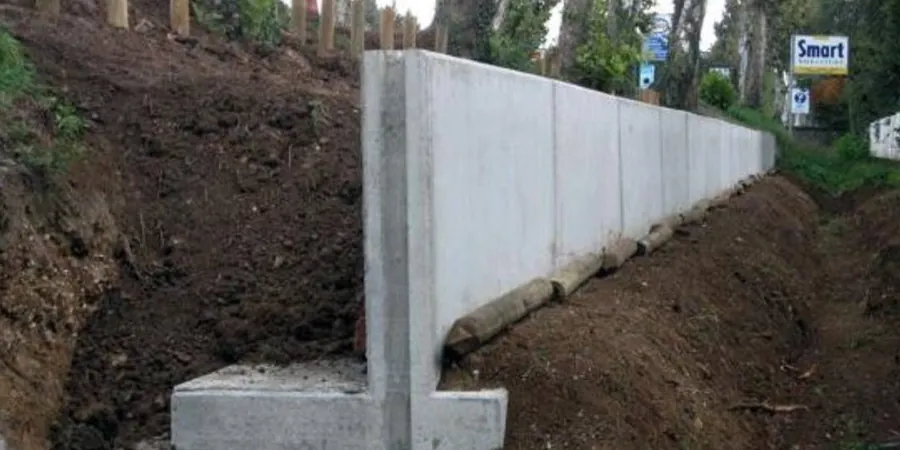
A contractor called us last spring about a project off Reynolda Road where a new commercial building needed a parking lot cut into a slope of silty residual soil. The grade change was over 14 feet, and the site sat directly adjacent to a creek with a fluctuating water table. That kind of scenario is common across Winston-Salem, where the Piedmont topography forces builders to confront elevation differences that demand a properly engineered retaining wall design. The engineering team visited the site, reviewed the existing test pits data, and immediately recommended a reinforced cantilever wall with a drainage system that could handle the seasonal saturation typical of decomposed gneiss and schist. Designing retaining structures here is not about applying a standard detail; it requires a methodical evaluation of lateral earth pressures, groundwater behavior, and the long-term stability of the backfill.
A retaining wall in the Piedmont is only as good as its drainage system. We design every wall assuming water will find a way behind it.
Scope of work
Area-specific notes
The residual soils across Winston-Salem, primarily silty sands and sandy silts derived from mica gneiss and schist, present a specific challenge for retaining walls: their strength is heavily influenced by moisture content and degree of weathering. A site on the north side of the city, near the Wake Forest University area, showed a 40% reduction in cohesion when samples moved from damp to saturated conditions. That magnitude of strength loss can transform a wall with an acceptable factor of safety into a marginal structure after a single heavy rain season. Another risk involves the depth to bedrock, which can vary from 5 to 50 feet within a single lot. Walls founded on partially weathered rock require careful evaluation of differential settlement and the potential for sliding along relict joint planes. When seismic loading is considered per ASCE 7, the horizontal acceleration can increase the driving forces enough to require a larger footing or deeper shear key.
Standards used
IBC 2021 – Chapter 18 Soils and Foundations, ASCE/SEI 7-22 – Minimum Design Loads and Associated Criteria for Buildings and Other Structures, ASTM D1586 – Standard Test Method for Standard Penetration Test (SPT), ASTM D2487 – Standard Practice for Classification of Soils for Engineering Purposes (Unified Soil Classification System), AASHTO LRFD Bridge Design Specifications – Section 11
Linked services
Site Investigation and Soil Parameter Development
We coordinate SPT borings, test pits, and laboratory testing to define the strength, compressibility, and drainage characteristics of on-site soils. These parameters feed directly into the wall design calculations.
Structural and Geotechnical Wall Design
Design of gravity walls, cantilever reinforced concrete walls, mechanically stabilized earth (MSE) walls, and soldier pile walls. Each configuration is checked for external stability (sliding, overturning, bearing) and internal structural capacity.
Construction Review and Instrumentation
During construction, we verify backfill compaction, drainage installation, and reinforcement placement. For critical walls, inclinometers or survey points can be installed to monitor performance during the first year of service.
Typical parameters
Common questions
What type of retaining wall works best in Winston-Salem's residual soils?
It depends on the cut height and site constraints. For cuts under 8 feet in well-drained silty sand, a gravity wall with a gravel backfill can work well. For taller cuts, reinforced cantilever walls or MSE walls are more common. The key is ensuring the foundation bears on competent soil and that the drainage system prevents water pressure buildup behind the wall.
How much does a retaining wall design typically cost for a residential project?
For a residential retaining wall design in Winston-Salem, fees generally range from US$1,010 to US$4,350 depending on wall height, complexity, and whether new subsurface exploration is needed. A simple 4-foot gravity wall with existing soil data falls at the lower end, while a 12-foot reinforced wall requiring new borings and detailed calculations is at the upper end.
Do I need a permit for a retaining wall in Forsyth County?
Yes, most walls over 4 feet in height require a building permit, and walls supporting a surcharge (like a driveway or building) may require an engineered design regardless of height. The City of Winston-Salem and Forsyth County both follow IBC requirements, and our design package includes the sealed calculations and drawings needed for permit submission.
How do you account for earthquakes in retaining wall design here?
Winston-Salem is in a moderate seismic region. We use the USGS Seismic Design Maps to obtain the site-specific spectral accelerations and calculate a horizontal seismic coefficient. The additional dynamic earth pressure from seismic loading is added to the static pressure, and the wall is checked for sliding and overturning under that combined load case per ASCE 7-22.
What drainage details do you specify for retaining walls?
We specify a continuous drainage blanket behind the wall using free-draining stone, a perforated collector pipe at the base, and weep holes through the wall face at regular intervals. The pipe outlets are directed to a stable discharge point. For walls in silty residual soils, we often include a filter fabric to prevent soil migration into the drainage stone.