The weathered saprolite mantling Winston-Salem's Triassic sedimentary basin creates a distinct challenge for compaction verification. Decomposed felsic gneiss and fine-grained sandstone-derived residuum often contain mica flakes that lubricate shear planes under load, making density acceptance criteria tighter than typical Piedmont sites. Our team deploys the sand cone apparatus (ASTM D1556/AASHTO T 191) across Forsyth County to verify that structural fill, pipe bedding, and pavement subgrades achieve 95-98% of modified Proctor maximum dry density. Testing depths typically extend to 150 mm (6 inches), sufficient to capture compaction effort in lifts placed over the partially saturated zone that fluctuates seasonally above the fractured bedrock aquifer supplying Winston-Salem's municipal wells. The difference between passing and failing often hinges on moisture conditioning of these micaceous silty sands, and our laboratory runs Proctor curves from bulk samples taken adjacent to each density test pit.
A single density test without matching Proctor reference data is just a hole in the ground—ASTM D1556 requires the companion D698 or D1557 curve to render the percent compaction meaningful.
Scope of work
Area-specific notes
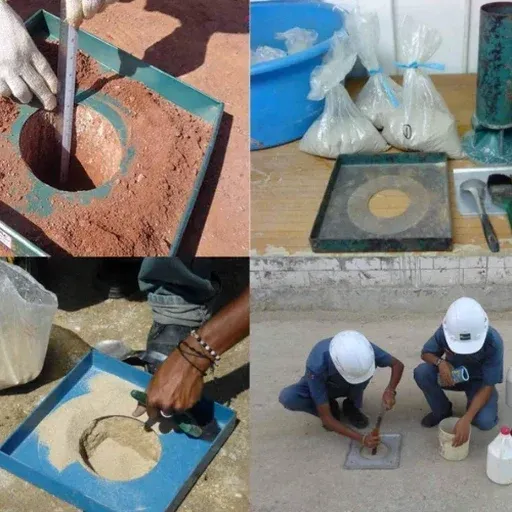
The sand cone apparatus used on Winston-Salem sites consists of a one-gallon plastic or glass jar threaded to a metal cone valve assembly with a 165 mm (6.5-inch) base plate—simple in principle, unforgiving of procedural shortcuts. The most common failure mode we encounter is sand loss around the base plate due to surface irregularities on graded fill, which introduces a volumetric error of 3-8% and falsely inflates the computed density. On silty sand subgrades near Salem Lake, where capillary rise from the reservoir keeps the top 300 mm near optimum moisture, operators must excavate the test hole with a spoon and trowel rather than a hammer-driven sampling tube to avoid sidewall compaction that artificially raises the density reading. For granular base course containing crushed stone larger than 19 mm, we apply the correction procedure in ASTM D4718 to adjust the laboratory maximum dry density for oversize particles, otherwise the field density result cannot be compared meaningfully against the Proctor reference. Every test hole is inspected for shape regularity before pouring sand; undercut sidewalls from platy mica grains are an automatic rejection criterion requiring a new test location offset by at least one plate diameter.
Standards used
ASTM D1556/D1556M-15e1, ASTM D698-12 (Standard Proctor), ASTM D1557-12e1 (Modified Proctor), ASTM D2216-19 (Moisture content), ASTM D4718-87(2012) (Oversize correction), AASHTO T 191
Linked services
Standard and Modified Proctor Compaction Curves
Laboratory determination of moisture-density relationship (ASTM D698/D1557) on representative bulk samples from Winston-Salem borrow sources, including the micaceous silty sands typical of the Cow Branch Formation.
Nuclear Gauge Density Testing (ASTM D6938)
Rapid in-place density and moisture readings using a Troxler or Humboldt gauge under USNRC license, calibrated to site-specific sand cone correlations for large-area pavement subgrade acceptance.
Grain Size Distribution and Oversize Correction
Sieve analysis (ASTM C136/C117) of base course and structural fill to determine oversize fraction, enabling corrected Proctor targets per ASTM D4718 for materials with +3/4 inch aggregate.
Typical parameters
Common questions
How much does a field density test using the sand cone method cost in Winston-Salem?
For sites within Forsyth County, a single sand cone density test including the companion laboratory moisture determination runs between US$90 and US$130. Volume pricing applies for projects requiring more than 10 tests per day, and the rate includes daily sand cone calibration and cone correction factor verification.
What minimum test hole volume does ASTM D1556 require for Winston-Salem's typical fill materials?
ASTM D1556 specifies a minimum test hole volume based on the maximum particle size in the material being tested. For the fine- to medium-grained saprolitic soils common across Winston-Salem, where maximum particle size rarely exceeds 12.5 mm (1/2 inch), the minimum volume is 710 cm³. For graded aggregate base course containing particles up to 25 mm, the required volume increases to 1,400 cm³.
How do you handle oversize particles in the field density result?
When the material contains particles retained on the 19 mm (3/4 inch) sieve, we apply the ASTM D4718 oversize correction. The field density test hole material is sieved to determine the percentage of oversize particles, the laboratory Proctor curve is recalculated to a corrected maximum dry density, and the field dry density is adjusted by subtracting the mass and volume of the oversize fraction before computing percent compaction.
What documentation do you provide after completing field density testing?
Each test report includes the test location marked on a site plan, test hole volume and mass, wet and dry density, moisture content, the Proctor reference curve identifier, percent compaction relative to the specified maximum, sand cone calibration data, cone correction factor, and a pass/fail statement against the project specification. All reports are signed and sealed by the project geotechnical engineer under our laboratory's ISO/IEC 17025 accreditation.