Red clay and silty sand define most construction sites across Winston-Salem. The Piedmont residual soils here weather directly from the underlying bedrock, creating fill materials that behave unpredictably when compacted. A Proctor test strips away the guesswork. It tells you the exact moisture content where that red clay reaches maximum density under a given compactive effort. Whether you are placing structural fill off Hanes Mill Road or backfilling a utility trench near the Wake Forest Innovation Quarter, the difference between Standard and Modified Proctor is not just a number on a report. It is the difference between a subgrade that stays put and one that settles unevenly after the first heavy rain. We run both ASTM D698 and D1557 in our laboratory, and we correlate results with field density checks like the sand cone density test to confirm the contractor is actually hitting the target in the trench.
A five-point Proctor curve on Piedmont residual soil is worth more than a textbook number. The shape of the curve tells you how forgiving the fill will be.
Scope of work
Area-specific notes
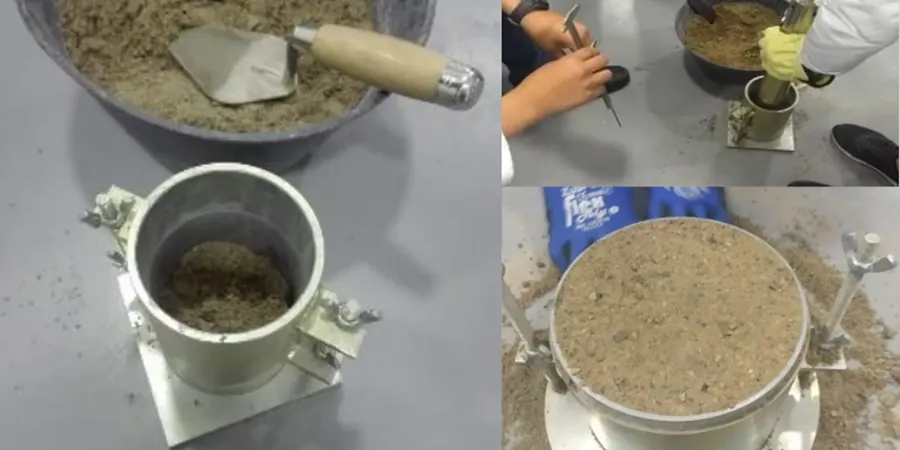
A mechanical hammer with a 10-pound weight drives the Modified Proctor test. The operator locks the mold into the base plate, drops the hammer 25 times per layer on five layers, and the whole rig shakes the bench. When that same compactive effort is specified for a parking lot subgrade in Winston-Salem, but the contractor actually has a smooth-drum roller that cannot deliver that energy, the result is a failed density test and a dispute. That is why we always ask what compaction equipment is on site before recommending Standard or Modified. Standard Proctor (ASTM D698) approximates the energy of a light roller or a walk-behind plate compactor, which is common for utility trenches and residential slabs. Modified Proctor (ASTM D1557) replicates heavy vibratory rollers and is typical for highway base courses and commercial building pads. If the owner insists on 98% Modified Proctor density on a fill with high clay content, the contractor may need to increase moisture and pass count significantly, or the material may need to be processed with lime. We have seen this exact scenario on a warehouse project off Union Cross Road.
Standards used
ASTM D698-12 (Standard Proctor), ASTM D1557-12 (Modified Proctor), ASTM D2487 (Soil classification), ASTM D6938 (Field density by nuclear gauge), IBC 2021 Section 1803 (Geotechnical investigations)
Linked services
Standard Proctor (ASTM D698)
One-point or five-point curve for residential slabs, utility trenches, and landscape fills. Turnaround in 24 hours with a signed report.
Modified Proctor (ASTM D1557)
Five-point curve for structural fills under commercial buildings, bridge approaches, and highway base courses. Includes zero-air-voids curve and optimum moisture recommendation.
Proctor + Field Density Package
We run the lab curve and mobilize a nuclear gauge technician to test each lift on site. Density reports are emailed the same day.
Typical parameters
Common questions
How much does a Proctor test cost in Winston-Salem?
A single Standard or Modified Proctor curve typically ranges from US$100 to US$220, depending on whether you need a one-point or a full five-point curve. Projects requiring multiple curves from different borrow sources get a volume discount.
Should I use Standard or Modified Proctor for my project?
It depends on the fill type and the compaction equipment on site. Standard Proctor works for residential slabs and shallow utility trenches where a walk-behind compactor is used. Modified Proctor is appropriate for highway base courses, commercial building pads, and any fill that will support heavy structural loads. We can review your geotechnical report and recommend the correct method.
How long does it take to get results?
Standard turnaround is 24 to 48 hours after the sample arrives at the lab, assuming the material is not overly wet and does not require extended drying. Same-day rush service is available if the sample is in our lab before 10 AM.
What soil types in Winston-Salem cause problems during Proctor testing?
Highly plastic residual clays derived from weathered felsic bedrock can absorb water slowly and require extended mixing time to reach uniform moisture. Micaceous silts found in some Piedmont deposits can produce misleadingly high dry densities due to the platy grain structure. We account for both in our sample preparation and report any anomalies on the curve sheet.