The subsurface conditions across Winston-Salem present a classic Piedmont profile that heavily influences deep foundation decisions. What appears as stiff clay at the surface often transitions into partially weathered rock—locally known as saprolite—within 15 to 30 feet, creating a bearing stratum that varies dramatically over short distances. In our laboratory, we routinely see Shelby and Enon series soils extracted from pile borings, where standard penetration resistances can jump from N=8 to refusal in a matter of feet. This geotechnical reality means that point-bearing piles socketed into competent mica schist or granite gneiss become the most reliable solution for structures exceeding three stories. The Triassic basin formations underlying the northeastern portion of the city add another layer of complexity, with sedimentary rock that weathers unpredictably and demands careful pile tip elevation verification during installation. For projects near the downtown core, where historic fill overlies natural ground, we often recommend combining deep borings with a CPT test to obtain continuous sleeve friction data that helps distinguish between natural saprolite and undocumented fill materials before finalizing pile lengths.
In Piedmont residual soils, the difference between a pile that holds and one that settles excessively is often 18 inches of additional socket into competent gneiss.
Scope of work
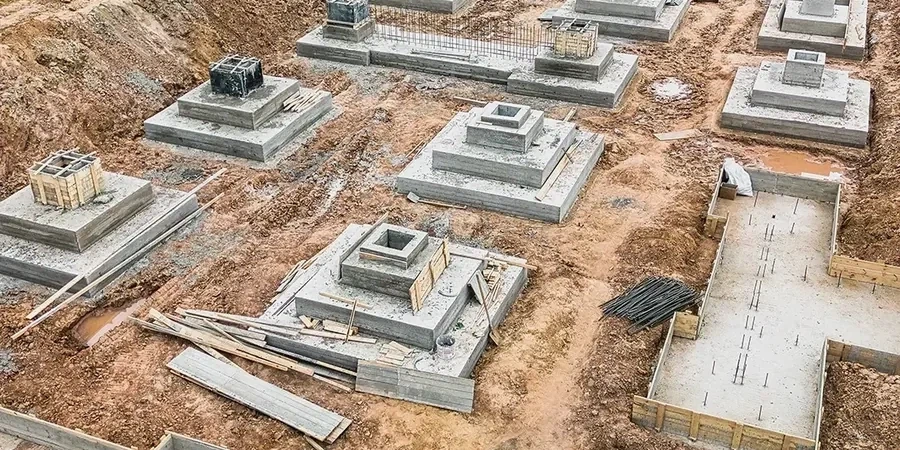
Area-specific notes
The abrupt transition from the Blue Ridge foothills to the rolling Piedmont plateau creates a topographic gradient across Winston-Salem that influences both surface drainage and subsurface erosion patterns, and failing to account for these in pile foundation design introduces risks that compound over time. The most significant concern we encounter is differential weathering depth: a pile terminated in highly weathered saprolite may track record 3 to 5 times more settlement than one socketed just 10 feet deeper into moderately weathered rock, even when both piles are on the same building footprint. This is exacerbated by the presence of diabase dikes that cut through the crystalline basement rock, creating hard, less-weathered ribs surrounded by softer, deeply weathered zones. Storm events with 24-hour rainfall exceeding 4 inches—which occur with roughly a 10-year recurrence interval in Forsyth County—can saturate the upper residual soil layer and temporarily reduce skin friction by 15 to 25 percent, a factor we incorporate into our service-level design checks. Additionally, the legacy of unrecorded underground storage tanks and abandoned utility corridors in older industrial parcels means that pre-construction geophysical surveys are not optional; striking an unknown void during auger drilling can destabilize adjacent ground and compromise pile integrity before concrete placement.
Standards used
ASTM D1586-18 (Standard Test Method for Standard Penetration Test), ASTM D2487-17 (Unified Soil Classification System), AASHTO LRFD Bridge Design Specifications, 9th Edition, IBC 2021 Chapter 18 (Soils and Foundations), FHWA-NHI-10-016 (Drilled Shafts: Construction Procedures and Design Methods)
Linked services
Deep Foundation Design & Analysis
Complete axial and lateral capacity calculations for driven piles, drilled shafts, and micropiles using AASHTO LRFD methodology. We perform t-z and p-y analyses calibrated to site-specific Shelby or Enon soil parameters, deliver pile group efficiency evaluations, and deliver installation criteria including minimum tip elevations and refusal definitions tied to blow counts or rock quality designation.
Pile Load Testing Program Management
Specification and oversight of static load tests, high-strain dynamic testing with PDA equipment, and Statnamic testing where rapid loading is advantageous. We interpret load-settlement curves to validate design assumptions, recommend production pile lengths, and document compliance with IBC acceptance criteria for owner and building official review.
Construction Phase Geotechnical Support
On-site observation during pile installation including socket inspection, concrete placement verification, and cross-hole sonic logging for shaft integrity. We respond to changed conditions—unexpected boulders, deeper weathering than anticipated—with real-time design adjustments that keep the project moving without compromising foundation performance.
Typical parameters
Common questions
What is the most common pile type used in Winston-Salem, and why?
Augered cast-in-place piles and drilled shafts dominate local practice because they can be socketed directly into the partially weathered mica schist that underlies much of the city. The ability to visually inspect the socket during construction and adjust depth based on actual rock quality—rather than pre-driving estimates—gives these methods a practical advantage over driven piles in Piedmont conditions where refusal can occur unpredictably.
How do you determine the required pile socket length into rock?
Socket length design depends on the unconfined compressive strength of the rock core, the rock quality designation (RQD), and the load demand from the structure. We typically recommend a minimum of 1.5 to 2 pile diameters of socket into competent rock with RQD greater than 50 percent, but this is verified through laboratory testing of core samples and adjusted for the presence of foliation planes that may reduce side resistance.
What does pile foundation design typically cost for a project in Forsyth County?
For most commercial and light industrial projects in the Winston-Salem area, pile foundation design works range from US$1,890 to US$6,430 depending on the number of piles, the complexity of the soil profile, and whether load testing is included. A straightforward design for a single-story addition with six to eight piles sits at the lower end, while a multi-story building requiring lateral analysis, group efficiency calculations, and PDA testing oversight falls at the upper end.
Does the seismic hazard in North Carolina affect pile foundation design here?
Yes, although the seismic hazard in the Piedmont is moderate compared to the West Coast, the IBC and ASCE 7 still require seismic design for structures in Winston-Salem, particularly those in Seismic Design Category C or higher. We evaluate liquefaction potential in saturated granular layers—rare but occasionally present in alluvial deposits along Salem Creek—and design pile connections to resist lateral demands from the design earthquake ground motion.